Instruction Fetch Stage (IF)
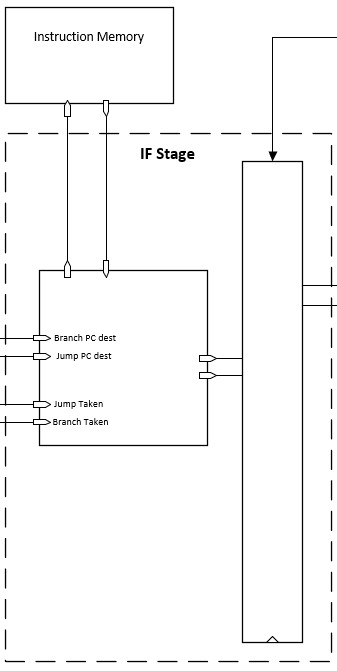
The Instruction Fetch stage (rtl/toast_IF_stage) drives the instruction memory interface. It is also responsible for passing new instructions and corresponding PC value to the ID stage. The instruction memory is word-addressable and misaligned access is not allowed.
Normal Operation:

As seen in the timing diagram, the IF stage places instruction addresses on the IMEM_addr_o bus. On the next clock edge, the instruction memory places the corresponding instruction on the IMEM_data_i bus.
The instruction address on IMEM_addr_o is flopped to align the fetched instruction with its PC value, and is passed onto the ID stage.
Conditional Branch Taken:
In the event that a conditional branch is taken, the IF stage requires two cycles to fetch the instruction corresponding to the branch destination PC.
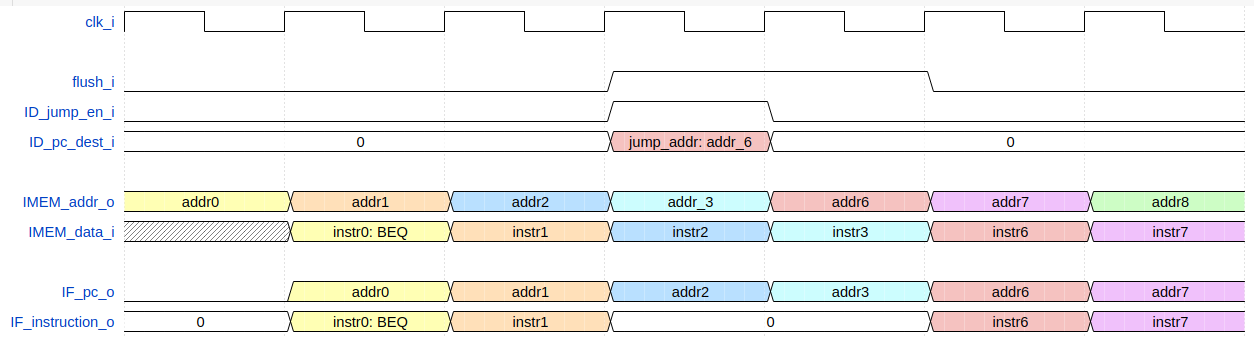
In this example, BEQ is taken on the fourth clock cycle, with a branch destination denoted as jump_addr.
After ID_jump_en_i is asserted, the IF stage places jump_addr on the IMEM_addr_o bus on the next rising edge, and the corresponding instruction is fetched on the cycle following that, resulting in a total of four cycles from when the BEQ instruction is fetched.
Jump Taken:
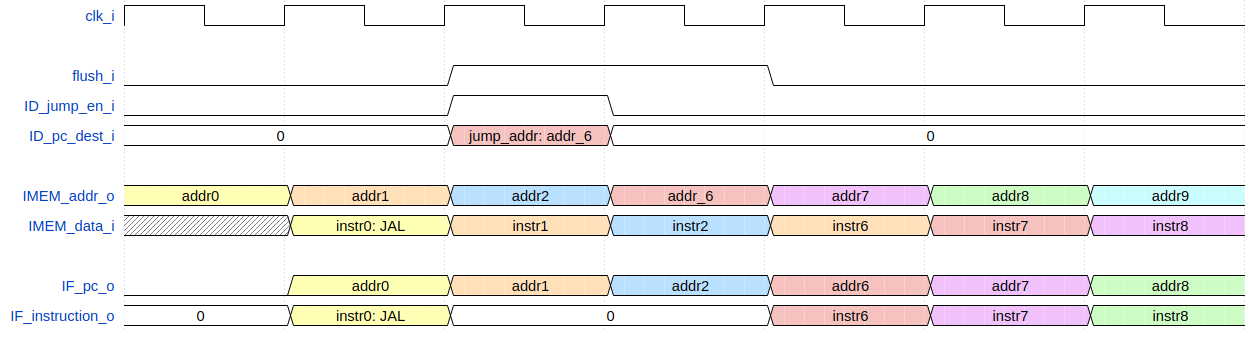
Unconditional jumps (JAL and JALR) are handled in the same manner and require four cycles to execute after being fetched.